
Christians should love to study God’s Word. It is a sad testimony to our remaining sin that we are often bored with the Bible and resistant to study it. One of the means and effects of pursuing maturity is a deeper desire to study God’s Word. Here are four practical helps to assist you in studying the most precious book on earth:
1. Study the Bible repentantly.
James 1:21 says, “Put away all filthiness and rampant wickedness and receive with meekness the implanted word, which is able to save your souls.” The reason we aren’t transformed by Scripture as we should be is mainly because our own wickedness keeps us from receiving and applying the Bible to our lives. This is the point of the parable Jesus told about the different kinds of soils. The seed is the same for each type of soil. In the first three types of soil, the Word is kept from thriving because of thorns, weeds, and rocks. So, when you come to God’s Word, spend some time confessing and forsaking your sin and freshly embrace Jesus Christ as your Savior and Lord. As you read, identify specific ways in which you have rebelled and find yourself rejoicing in Christ.
2. Study the Bible prayerfully.
Ephesians 4:18 says that, apart from Christ, we are darkened in our understanding. On our own, we will never be able to understand and apply God’s Word. We need God’s help to open our eyes and allow us to see His glory. Thus, the Psalmist prayed, “Open my eyes that I might see wonderful things in Your word” (Psalm 119:18). The Psalmist understood that he needed God’s help and so he asked God for supernatural assistance. Our constant plea should be, “Help” as we read God’s Word. Charles Spurgeon said, “If you would understand the Word of God in its difficult points, if you would comprehend the mystery of the gospel of Christ, remember, Christ’s scholars must study upon their knees.”
3. Study the Bible constantly.Psalm 1 encourages us to meditate on God’s Word “day and night.” We are to not just study the Bible every now and then. We are to study the Bible all the time. This makes sense doesn’t it? Maximum exposure to God’s Word will lead to maximum transformation in our lives. Donald Whitney wrote, “Little Bible intake will result in little resemblance to God’s Son.” Let’s figure out ways to maximize our intake of Scripture.
4. Study the Bible purposefully.
What should be our purpose in studying the Bible? I propose that we should not study Scripture merely to gain information (although that will certainly happen), but to study the Bible in order to encounter Jesus Christ. Every page, chapter, story, command, and event is meant to reveal the glory of the Savior. The Bible is not merely a manual for how to live successfully. The Bible reveals God’s sovereign purposes to center everything in the universe on Jesus Christ. John Calvin said, “The scriptures should be read with the aim of finding Christ in them.” Whenever we lose sight of the hill of Calvary, we have lost our way.
Thankful for God’s Word,
Pastor Justin
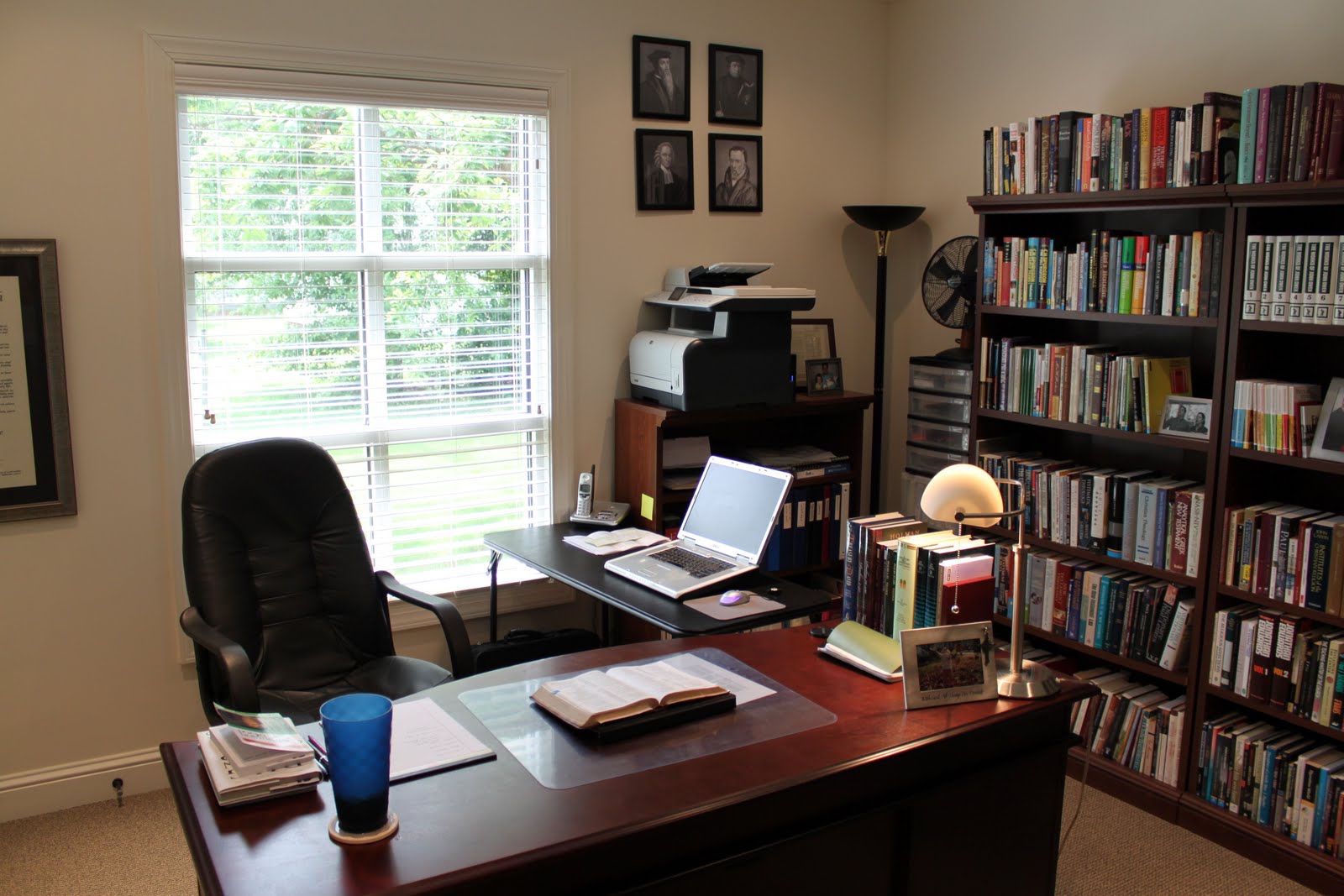 This is what you will see when you walk in the door. I've got a great window that allows plenty of sunlight and access to all sorts of birds and creatures that don't know I'm watching them.
 I always put the commentaries of the book I'm preaching through right on my desk for easy access. We are doing a summer series through Psalms right now.
 I've turned my closet into a prayer closet. This is a custom prayer bench I had made about 5 years ago. I have a copy of our church prayer directory there and try to pray through it twice a month.
 I have my books arranged in categories. The left shelf is biographies, preaching, bible study, theology, marriage, etc. The other left shelves are arranged alpha by author. The 2 right shelves are all my commentaries arranged by book of the Bible.
 A closer view of one of the shelves. Works of Owen and Bunyan.
 The commentary shelves are directly across from my desk.
 These pictures are the most popular aspect of my office. They are clearly visible when you walk in and everyone wants to guess who they are. Top: Calvin and Luther. Bottom: Edwards and Tyndale.
 The Piper shelf (that is no longer able to hold all my Piper books).
 Books on the Cross, the church, and Piper overflow.
 Our church covenant signed by the first members of Christ Baptist.
 And no office is complete without a "snack drawer." This is my kids' favorite part of my office.


